
Of Chimpanzees and Children
This article compares two separate studies of chimpanzee and child imitation, examining how the findings of outcome-focused behaviour in autistic children was framed in stark contrast
PSYCHOLOGYCONSCIOUSNESSSYSTEMS
Alexandra Chambers
7/11/20265 min read
The biggest lie ever told is that the method matters more than the outcome.
In Horner and Whiten’s 2005 experiment, chimpanzees and typically developing (non-divergent) young children watched a demonstrator retrieve a reward from a puzzle box using both necessary and visibly unnecessary actions. Once the causal mechanism was clear, the chimpanzees abandoned the irrelevant steps and reproduced the outcome by a more efficient route. The children, however, continued copying the complete procedure, even “at the expense of efficiency.” Researchers termed the chimpanzees’ strategy emulation: learning from the result rather than unnecessarily reproducing every detail of the demonstrated method.
Later research by Marsh et al. (2013) found that compared to typical children, autistic children were also substantially less likely to copy unnecessary actions while pursuing a goal. The autistic children still achieved the objective, but the difference was framed through reduced social motivation and conformity.
The contrast is stark:
Chimpanzees removing unnecessary actions: framed by Horner and Whiten (2005) as efficient, flexible and potentially adaptive.
Autistic children removing unnecessary actions: framed by Marsh et al. (2013) as reduced affiliation, conformity and social motivation.
Prioritising the objective over procedural ritual is not an absence of intelligence. Under an outcome-and-efficiency definition, the autistic children performed more efficiently. They reached the goal while carrying out roughly half as many irrelevant actions as either typical group.
The researchers nevertheless did not call this better performance, because the construct they were defining was social imitation. They treated copying unnecessary actions as evidence of affiliation or conformity and interpreted the autistic children’s lower copying as reduced “social motivation.” They even called it a “failure” to copy unnecessary actions, despite acknowledging that the children understood the goal and could perform the more complicated necessary actions.
Marsh et al. (2013) connected reduced overimitation with “profound difficulties with social engagement” and ultimately treated reduced social motivation as the best explanation, even though motivation to affiliate or conform was not directly measured.
That is a choice to make typical conformity the positive reference standard and to place autistic efficiency inside a deficit narrative.
A method is a tool, not a moral authority. To reach a valid outcome by any effective and ethical means is success. An approved procedure that fails remains failure; an unconventional route that works does not become invalid merely because it was not the route prescribed.
I propose the term observer-defined ontology to describe the process by which observers do not merely interpret a phenomenon, but establish the conceptual reality within which it is defined, measured and assigned meaning. This should not be confused with observer bias, although both are present in this example. Observer bias concerns how researchers interpret what they see; observer-defined ontology concerns the deeper process by which researchers construct the categories through which the phenomenon is allowed to exist at all. In Marsh et al. (2013), the researchers defined socially faithful copying as meaningful, treated reduced copying as a possible failure of affiliation, and operationalised rationality through a researcher-designed “sensible–silly” rating scale. In doing so, they established the standard against which the children’s behaviour would be judged, while privileging typical social conformity over functional efficiency.
These studies also reveal the tendency in research to cross-species interpretive asymmetry, or species-contingent attribution bias, in which functionally comparable behaviour is assigned a different meaning according to the identity of the subject performing it. The experiments were not identical, and the behaviours should therefore be described as functionally comparable rather than equivalent; nevertheless, the contrast exposes a clear interpretive double standard. This further illustrates observer-defined ontology: meaning is not derived from behaviour alone, but from the conceptual reality imposed upon the category of being observed.
The contrast in this case can also be understood as an ableist inversion of anthropofabulation. Anthropofabulation ordinarily describes the idealisation of human cognitive capacities while comparable animal capacities are interpreted more restrictively (Buckner, 2013). Here, however, the direction of attribution is reversed: the chimpanzees’ omission of unnecessary actions was permitted to signify efficient, flexible and adaptive cognition, while a functionally comparable pattern in autistic children was interpreted through reduced affiliation and social motivation. This does not necessarily mean that the animal was valued more highly than the human in any general sense.
The deeper issue is that the supposedly idealised category of “the human” is not applied equally to all humans. It usually represents the normative, non-autistic human. Autistic children can therefore be placed outside the privileged human reference category: a capacity admired in an animal becomes pathologised when expressed by a human whose cognition diverges from the accepted norm. Research has documented wider patterns in which autistic people are denied qualities associated with agency, rationality, sociality, and full human status (Cage, Di Monaco and Newell, 2018; Botha and Cage, 2022). Observer-defined ontology therefore operates not only between humans and animals, but within humanity itself, determining whose behaviour is permitted to represent intelligence and whose is made to signify deficit.
The autistic children achieved the practical objective while reproducing fewer unnecessary actions, yet this behavioural economy was interpreted through a deficit framework because the ontology of the experiment had already positioned conformity as competence. The result is therefore not only a biased interpretation of the evidence, but a biased construction of the reality within which that evidence acquired meaning.
In metaphorical terms, observer-defined ontology can be understood as structurally similar to an AI hallucination. When an AI is asked, “What colour is my dress today?” despite the person not wearing a dress, the AI will likely accept the false premise, invent the missing object and confidently answer with a colour. The error does not begin with the colour; it begins with the unexamined assumption that the dress exists. Research operates in the same way when observers define a phenomenon incorrectly before measuring it. If a study assumes, for example, that reduced imitation is inherently a deficit, it will likely generate internally consistent findings about the causes and severity of that 'deficit' without first establishing that the behaviour is pathological at all.
The methods may be rigorous and the data accurately recorded, yet the conclusion remains ontologically false because the study is measuring a reality created by its own premise. Observer bias inaccurately describes an existing dress; observer-defined ontology invents the dress and then publishes detailed measurements of it.
References
Botha, M. and Cage, E. (2022) "Autism research is in crisis”: a mixed method study of researcher’s constructions of autistic people and autism research’, Frontiers in Psychology, 13, article 1050897. doi: 10.3389/fpsyg.2022.1050897.
Buckner, C. (2013) ‘Morgan’s Canon, meet Hume’s Dictum: avoiding anthropofabulation in cross-species comparisons’, Biology & Philosophy, 28(5), pp. 853–871. doi: 10.1007/s10539-013-9376-0.
Cage, E., Di Monaco, J. and Newell, V. (2018) ‘Experiences of autism acceptance and mental health in autistic adults’, Journal of Autism and Developmental Disorders, 48(2), pp. 473–484. doi: 10.1007/s10803-017-3342-7.
Horner, V. and Whiten, A. (2005) ‘Causal knowledge and imitation/emulation switching in chimpanzees (Pan troglodytes) and children (Homo sapiens)’, Animal Cognition, 8, pp. 164–181. DOI: 10.1007/s10071-004-0239-6.
Marsh, L., Pearson, A., Ropar, D. and Hamilton, A.F. de C. (2013) ‘Children with autism do not overimitate’, Current Biology, 23(7), pp. R266–R268. DOI: 10.1016/j.cub.2013.02.036.
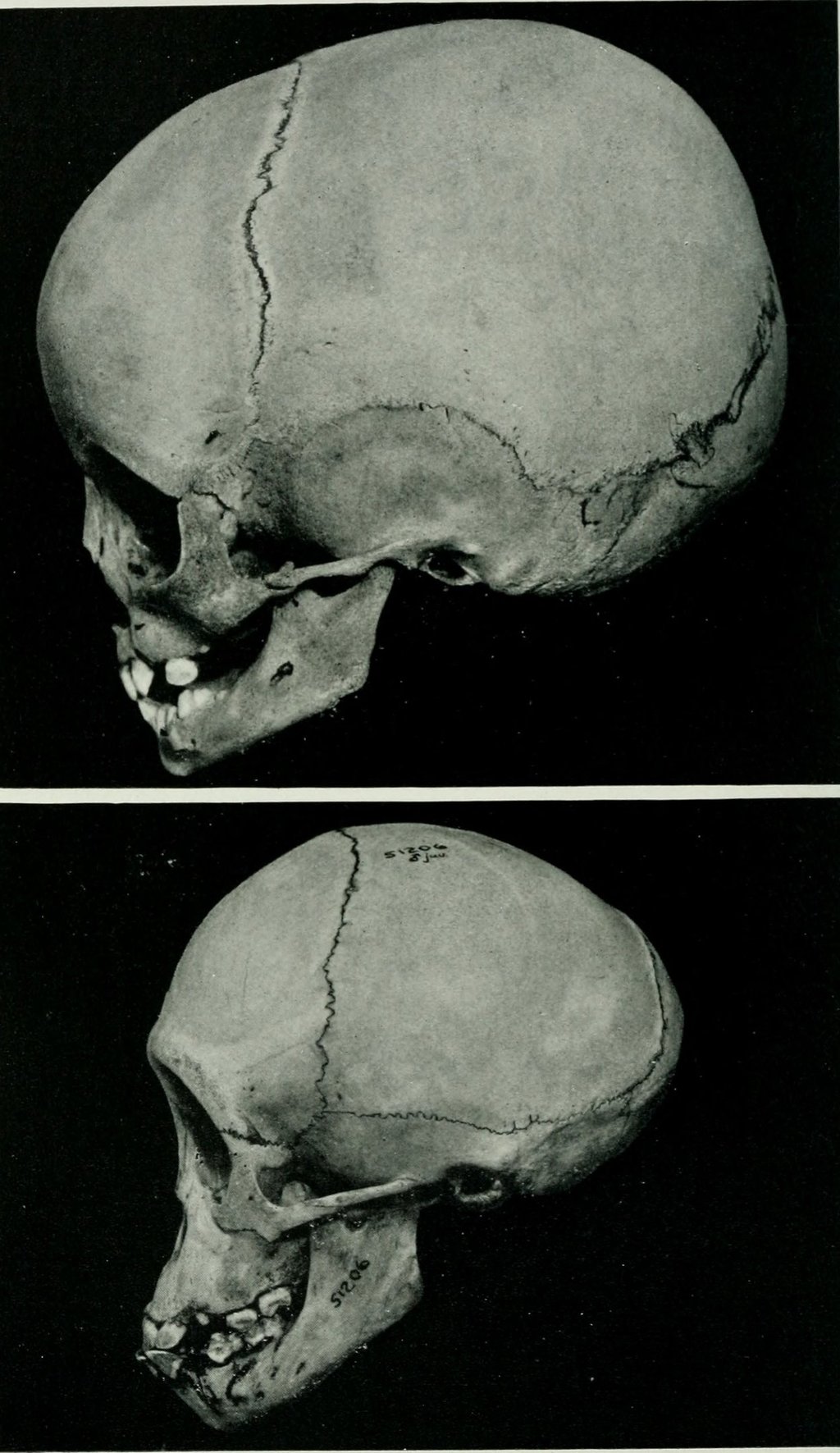
Skulls of Human Infant and Young Chimpanzee, from The American Museum Journal, c. 1918. American Museum of Natural History Library/Biodiversity Heritage Library. No known copyright restrictions.