
The Adaptation - Evolution - Degeneration Framework: A Biopsychosocial Model of Conscious Human Development
This article explores evolution through a wide biopsychosocial systems-oriented lens, and proposes the term anthrosystemorphosis as the reorganisation of ecological and biological conditions through human-governed systems
EVOLUTIONEXPOSOMESYSTEMSCONSCIOUSNESSEPIGENETICS
Alexandra Chambers
4/21/20268 min read
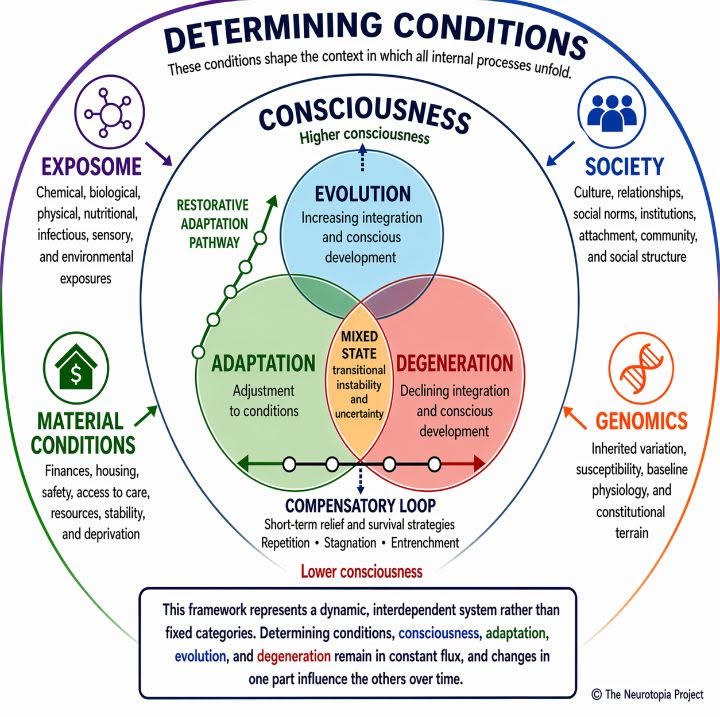
This evolutionary framework distinguishes between adaptation, evolution, and degeneration, and identifies a compensatory survival loop therein.
Adaptation is adjustment in response to conditions. It describes how an organism, mind, or society responds to pressure, threat, instability, or opportunity. Adaptation may be protective, compensatory, constrictive, or supportive. It does not, by itself, indicate the direction of development.
Evolution, in this framework, refers to increasing integration, refinement, and conscious development across biological, psychological, and social domains. It is reflected in strengthening immune competence, increasing disease resilience, improving regulation, refining cognition, deepening emotional intelligence, increasing empathy, and strengthening social coherence.
Degeneration refers to declining integration, declining regulation, and increasing fragmentation across those same domains. It may involve immune dysregulation, reduced disease resilience, impaired recovery, cognitive fragmentation, emotional blunting, reduced empathy, narrowing awareness, and rising dependence on external systems.
Degeneration is a trajectory of integrated decline across the biopsychosocial system.
These processes overlap; adaptation can support evolution, and paradoxically drive degeneration. The determining conditions are key to the direction of adaptation. A system may remain highly adaptive while moving in a downward direction overall.
The compensatory loop describes a state in which adaptation preserves immediate function without producing genuine resolution or forward development. The system learns to compensate for strain, instability, or damage through short-term survival strategies that reduce immediate risk or discomfort, but these strategies often become repetitive and energetically costly. As a result, the appearance of stability may be maintained while deeper repair, integration, or transformation fails to occur. This creates a form of stagnation: the system is not fully collapsing, but neither is it progressing. Over time, entrenched compensation can narrow flexibility, reinforce dependency, and increase vulnerability to degeneration. The compensatory loop therefore represents a critical middle state in which adaptation is still active, but its direction has become arrested rather than developmental.
This distinction is clearer when examined through a biopsychosocial lens. Biological, psychological, social, and consciousness-related processes are interdependent. Immune function affects cognition. Cognition affects disease management. Emotional regulation affects physical stress burden. Social coherence affects safety, and caregiving.
In this framework, consciousness refers to the capacity for awareness, reflection, accurate perception, and intentional regulation across self, others, and environment. Consciousness also affects whether these changes are perceived clearly, interpreted accurately, and acted upon. Consciousness is therefore not only one domain within the framework; it also mediates the others. As conscious awareness declines, the capacity to recognise degeneration may decline with it. A population may become sicker, more fragmented, less empathic, and more dependent while becoming less able to perceive that pattern clearly.
Consciousness can function as a leverage point within the system, influencing whether adverse conditions produce constrictive adaptation, compensatory looping, or a bridge toward more integrative development.
This framework also changes how development is judged. Technical complexity is not, by itself, evidence of upward human development. A society may increase in technological sophistication while declining in health, empathy, regulation, reflective depth, and social coherence. Under those conditions, adaptation and degeneration may be occurring together.
Evolutionary change describes that traits have shifted. It does not, by itself, explain why those shifts occurred, what conditions produced them, or whether their downstream effects reflect integration, compensation, or decline.
Natural genetic selection may still occur under industrial conditions, but once the determining pressures are dominated by pollution, pharmaceuticals, toxic exposure, and systemic distortion, describing the process as natural selection risks obscuring the artificial nature of the environment shaping the outcome.
The framework is not absolute. Adaptation, evolution, and degeneration are not fixed categories but overlapping processes that may coexist within the same system at the same time. A person, organism, or society may be adaptive in one domain, evolving in another, and degenerating in another still. The model therefore describes directional tendencies rather than pure states. Its purpose is not to reduce, but to make visible the interaction between coexisting processes and the overall direction in which systems are moving.
Organisms develop, survive and reproduce within determining conditions: genomic architecture, developmental history, material circumstances, ecological context, social environment and the accumulated field of exposures often described as the exposome. The exposome is central to this framework. It includes the chemical, nutritional, microbial, sensory, technological, psychosocial and environmental conditions through which biological potential is expressed, buffered, constrained or damaged. Genes do not act independently of the environments in which bodies develop. The same genetic architecture may produce very different outcomes depending on nutrition, stress, toxic burden, microbial ecology, endocrine disruption, illness, medication exposure, sensory conditions, housing, work and access to care.
This means that biological outcome emerges through interaction: genotype, regulation, development, exposure and history acting together.
Adaptation is often treated as evidence of evolutionary success. However, adaptation can also take the form of compensation, suppression, chronic stress physiology, reduced developmental expression or the narrowing of biological capacity. An organism may survive an adverse environment by reallocating energy, dampening immune response, suppressing sensory processing, altering endocrine function or reducing reproductive investment. Such adjustments may preserve short-term survival while increasing long-term burden.
Adaptation to harm is not necessarily evidence of flourishing.
A population may appear to function within a damaging environment while carrying higher rates of illness, developmental disruption, reduced fertility, altered behaviour, chronic inflammation, exhaustion or intergenerational disadvantage. Survival alone does not establish that the conditions are benign, optimal or evolutionarily desirable. Human development beyond debilitating environments requires a higher state of consciousness: the capacity to perceive the conditions shaping life, understand their consequences across bodies and generations, and reorganise them accordingly. If decline across health, regulation, empathy, awareness, and social coherence is not recognised, then it is likely to persist.
The term 'anthropogenic selection' is useful. It refers to selection pressures produced by human activity: pollution, pesticides, industrial food systems, habitat fragmentation, artificial light, climate disruption, technological environments and chemical exposure.
The problem is that it is too undifferentiated. “Anthropogenic” identifies humanity as the source of a pressure, but it does not distinguish between humanity as a whole and the systems through which exposure is actually produced, regulated and distributed.
Most people do not decide chemical regulation, agricultural policy, industrial discharge limits, housing standards, occupational exposure rules, food production systems, technological design or healthcare thresholds. The relevant causal unit is therefore often not humanity in the abstract, but a structured arrangement of institutions, technologies, incentives, supply chains, regulatory permissions and material infrastructures.
A community exposed to contaminated water did not collectively create the system that contaminated it. A child born into polluted housing did not participate in the decisions that made that exposure possible. A farmer may operate within an agricultural system whose economic structure makes lower-exposure alternatives difficult or inaccessible. “Human-caused” may be technically accurate while still concealing who possessed the power to create, maintain or alter the conditions.
Human-governed systems can generate selection pressures in the population-genetic sense when they alter survival, reproduction or reproductive contribution. Describing these outcomes only as “natural selection” can obscure that the exposure landscape was designed, regulated, permitted or maintained through identifiable systems of governance.
Preventable conditions should not be treated as inevitable ecological facts.
Anthrosystemorphosis
This Divergent Genomics evolutionary framework proposes a new term anthrosystemorphosis.
«Anthrosystemorphosis: the reorganisation of ecological and biological conditions through human-governed systems that redistribute exposure, physiological burden, viability and adaptive demand across populations.»
Anthrosystemorphosis is broader than selection. A system may alter developmental and ecological conditions without producing inherited evolutionary change. It may increase toxic burden, reduce nutritional buffering, disturb microbial ecologies, alter reproductive timing, destabilise endocrine systems, intensify chronic stress, reshape habitats, increase technological dependency or reduce access to restorative environments.
These conditions may induce epigenetic change, chronic illness, ecological disruption or population decline without necessarily shifting allele frequencies.
Anthrosystemorphosis names the larger process through which systems restructure the environment in which organisms must function: what they encounter, absorb, metabolise, compensate for, reproduce within and pass to subsequent generations.
It also makes visible the point at which biological consequence intersects with governance.
Populations are biologically heterogeneous. People differ across polygenic variation, regulatory architecture, metabolism, immune signalling, endocrine function, mitochondrial capacity, connective tissue, vascular biology, developmental timing, neurological processing, microbial ecology and accumulated exposure history. The same environmental pressure can therefore produce very different outcomes in different bodies.
A pressure that is tolerable for one person may exceed the compensatory capacity of another. The difference may arise through combinations of genetic variation, structural variants, epigenetic regulation, developmental history, nutritional status, chronic illness, medication exposure, prior stress or cumulative physiological burden.
A population study may suggest that an exposure is generally tolerated while concealing a subgroup for whom the same exposure produces disproportionate harm. That subgroup is not biologically defective; it reveals that the system has been designed around a narrow and falsely universal model of human tolerance.
Under substandard conditions, harm does not automatically demonstrate innate deficiency. It may demonstrate incompatibility between a biologically complex organism and a system designed around a reduced model of human tolerance. The language of “fitness” is especially misleading in this context. It can imply that those harmed by a system are intrinsically less viable, less capable or less evolved, but the Divergent Genomics framework offers another interpretation.
Some people may possess forms of neurological, sensory, metabolic or developmental complexity that require organic conditions, greater recovery time, more precise regulation or lower toxic burden. Traits such as increased cognitive agility, heightened interoception, exceptional sensory perception, wide associative processing, atypical developmental plasticity or complex regulatory demand may be valuable within responsive environments.
Yet those same traits may become disproportionately vulnerable within environments organised around sensory suppression, chemical tolerance, rigid temporal demands, synthetic nutrition, chronic stress and narrow assumptions about cognition and bodily regulation.
A system may reward forms of tolerance that are useful only within the conditions that system has created. It may burden those whose biology is more sensitive, more metabolically demanding, more developmentally plastic or less able to compensate for environmental disruption.
Some populations may appear to tolerate toxicity better than others, but tolerance is not superiority. Designing population-wide interventions around those least affected is an evolutionary risk.
A population that contains a wide range of metabolic, immune, neurological and developmental capacities are likely far more resilient to future ecological change than one shaped around a narrow tolerance profile. The goal should not be to identify which bodies can endure the greatest burden. The goal should be to reduce the burden and preserve the range of biological diversity.
Anthrosystemorphosis distinguishes between environmental burden, differential biological effects, selection and population-level evolutionary change.
Anthrosystemic pressure is a condition generated or maintained through a human-governed system. It may include a contaminant, food regime, infrastructure failure, technological dependency, policy-created deprivation, altered habitat, occupational exposure or chronic stress environment.
Anthrosystemic filtering occurs when that pressure affects organisms unevenly. Some may compensate, some experience illness, developmental disruption, altered behaviour, reduced fertility, increased mortality or reduced capacity. Others may be more protected through biological, ecological or social buffering. Filtering is not automatically selection. Anthrosystemic selection occurs only when differential effects are connected to heritable variation and alter reproductive contribution across generations.
Anthrosystemic evolution occurs only when those effects produce measurable inherited population-level change. A system changes the environment in which whole organisms must function. Selection, where it occurs, acts through phenotype: the integrated outcome of genotype, development, exposure and history. This is why any claims about “genes for resilience” are inadequate. A variant may be neutral in one context, protective in another and harmful in a third. Its effects depend on the wider organism and the environment in which that organism develops.
Human exposure is not randomly distributed. Housing, poverty, occupation, disability, nutrition, healthcare access, geographic location, race, class, political exclusion and environmental regulation all shape who encounters a pressure, for how long and with what ability to avoid it. Biological outcome differences therefore cannot be interpreted as evidence of genetic selection without accounting for social structure.
A higher disease burden in one population may reflect unequal exposure, unequal access to care, differential diagnosis, occupational concentration, food insecurity, housing conditions or environmental neglect rather than inherited biological differences. However, the existence of social confounding does not make biological heterogeneity irrelevant. Social systems shape exposure, and biological variation shapes response. A progressive analysis must examine their interaction rather than reducing everything to one side.
Anthrosystemorphosis therefore connects social analysis with biological analysis. It asks how systems distribute exposure, how bodies respond differently to that exposure, and whether those unequal effects become embedded across generations.
Anthrosystemic governance is the decision-making layer that determines how exposure landscapes are created and maintained. It includes regulators, industries, infrastructure owners, medical institutions, agricultural systems, technology platforms, procurement structures, employers, policymakers and economic arrangements. Governance determines which harms are measured, which thresholds are treated as acceptable, which populations are considered representative and which forms of vulnerability are dismissed as exceptional.
A system may produce biological harm through ignorance, institutional inertia, fragmented regulation, poor measurement, weak accountability or economic incentives rather than explicit intent to harm.
However, once disproportionate burden becomes visible, continuation is no longer neutral. It becomes a governance decision.
This understanding requires recognition that preventable harm can persist through systems that normalise it, obscure or misrepresent it, distribute it unevenly or dismiss those affected as 'rare' and statistically expendable.