
Perception, Cognition, Consciousness and Embodied Coherence
This article discusses how we process and think in multi-layered streams - and how cognitive processes are influenced. This article also explores how neurological complexity is pathologized for presenting as 'dysfunction' in those operating across multiple streams of consciousness
CONSCIOUSNESSPSYCHOLOGY
Alexandra Chambers
7/16/20266 min read
How we process the external world is not separate from how we process internally - it is the visible edge of the same system.
Every external stimulus must be detected, filtered, prioritised, interpreted, connected to memory, given emotional and bodily meaning, and then translated into a response.
To understand ourselves and others fully we must first perceive externalized behaviours accurately.
What we notice, what overwhelms us, what we ignore, what we return to, and what we need to do with the information all reveal something about the architecture performing those operations.
A person who notices tiny changes in sound, language, facial expression or pattern may be taking in information at a higher resolution, compressing it less aggressively, or maintaining more of it simultaneously. That same processing style may appear internally as complex association, vivid imagery, or intense reflection. The external detail and the internal complexity may be two expressions of the same underlying organisation.
An apparent need for routine may be less about rigidity than about the amount of internal processing already occurring. Predictability outside can create enough stability for complexity inside. When a person is tracking multiple possibilities, sensory signals, emotional undercurrents and future consequences at once, external structure reduces the number of variables that must continually be recalculated.
External behaviours can therefore function as processing tools. Pacing could help to organise thought. Repetitive movements may regulate rhythm and energy. Speaking aloud may convert simultaneous internal information into a linear sequence that enables inner clarity. Withdrawal may protect a system that has exceeded its capacity to integrate further input. These behaviours reveal that cognition processing style in real time.
The body also participates before anything reaches what we conventionally call the mind. Light passes through the eye; sound is mechanically transmitted through tissue; touch is shaped by skin, fascia and pressure receptors; balance depends upon the vestibular system; internal sensation is affected by vascular, immune, metabolic and autonomic states. The nervous system does not receive a neutral copy of the world. It receives signals already shaped by the particular body through which they travelled.
External sensory processing can therefore offer clues not only to neurological interpretation, but to the person’s wider biological architecture.
Perception is adjacent to consciousness because consciousness transforms sensory processing into an experienced, integrated world. Without consciousness, the nervous system can still detect, discriminate and respond to information, but that processing is narrower, less globally available and not subjectively experienced in the same way.
For example, unconscious processing can still:
register threat,
orient attention,
recognise patterns,
guide movement,
influence emotion and decision-making.
However, higher consciousness seems to allow perception to become available for reflection, comparison, memory, meaning, deliberate action and communication. It lets the organism perceive not only the stimulus, but something more like: this is happening, it is happening to me, it resembles something from before, and it is important for this reason.
Someone who perceives fine distinctions externally may also think in nuanced systems and complexity rather than categories. This is not absolute, but it suggests that perception, cognition, emotion and embodiment may share a characteristic processing signature.
This reverses the usual direction of interpretation. Instead of asking why someone cannot tolerate an ordinary environment, we might ask what their response tells us about the environment they are actually receiving. Instead of suppressing the outward expression, we can study its function. What creates overload? What restores coherence? What must be made visible, rhythmic, predictable, embodied or external before it can be processed?
External processing is therefore both a clue and a key. It is a clue because it reveals otherwise inaccessible internal operations. It is a key because changing the external conditions - reducing distortion, providing structure, permitting movement, making information visual, allowing time - can unlock capacities that were present internally but could not be expressed under conditions of mismatch.
The way a person meets the world is the embodied system showing us how it is built.
A layered neurological system may automate familiar external tasks precisely so that consciousness can remain occupied elsewhere.
Someone may be washing dishes, walking a known route or completing a repetitive task with very little conscious supervision, while simultaneously analysing a problem, rehearsing a conversation, forming associations, monitoring bodily sensations and responding cognitively to several internal tasks.
The person is not operating with less consciousness, their conscious processing may be intensely active but displaced from the immediate task.
That creates a strange combination:
high internal complexity alongside low external attentional presence;
competent automatic action alongside missed details;
deep thought alongside apparent distractibility;
rapid association alongside difficulty directing or stopping it;
reduced awareness of the routine task alongside excessive awareness of everything else.
This is very recognisable in ADHD.
Automaticity can free cognitive capacity, but the released capacity may be captured by whatever is most novel, emotionally charged, unresolved or associative.
Meanwhile, background sensory input, bodily signals and unfinished thoughts may continue competing for processing.
That can become overwhelming because the system is not merely switching between one external task and one internal thought. It may be maintaining several layers at once, each with different levels of awareness. The autopilot is carrying the body through one sequence while consciousness is operating somewhere else - and yet the automatic layer still requires enough monitoring to prevent errors. A disruption then forces all the layers to collide: the person loses their place externally, loses the internal train of thought, and must reconstruct both.
The distinction is where consciousness is located, how many layers are operating simultaneously, and how much control the person has over which layer reaches the foreground.
In ADHD, the problem is not necessarily an absence of attention, as much as an abundance of active processing across multiple tiers of consciousness.
The mundane task is cognitively small, but it still demands initiation, sequencing, motor supervision, working memory and repeated decisions: pick this up, rinse that, put it there, notice what remains. It pulls consciousness down into a narrow, immediate operational mode.
Meta-consciousness (a term I've used here to describe the primary active lens of conscious cognition - likely experienced as a form of hyperfocus) operates differently. It holds broader structures together: long chains of thought, multiple perspectives, abstract relationships, self-observation, future consequences and the coherence of the whole. That kind of processing often depends on continuity, and it cannot always be paused and resumed cleanly.
Therefore the difficulty is switching between different orders of consciousness:
immediate, procedural consciousness;
associative or reflective consciousness;
And meta-consciousness that operates a convergent primary pathway.
A person may be cognitively capable of all three, even simultaneously, but lack reliable control over which one is consciously prioritised, how much capacity each receives, and whether the larger structure survives the transition.
Washing a pot may seem trivial from outside, yet the shift into that level can collapse or fragment a complex internal model that took hours to assemble.
This may explain why ordinary demands can feel disproportionately disruptive. They do not just occupy time - they alter the level at which the mind must operate. The person then has to reconstruct context, emotional orientation, conceptual position and momentum before returning to the higher-order process.
The embodied mind assigns conscious importance. It moves towards certain forms of information and away from others. It preserves some trains of thought, resists interruption, returns repeatedly to unresolved problems and sometimes refuses to allocate much energy to tasks it experiences as low-value.
That may be the system revealing what it is organised to do.
This reframes apparent executive dysfunction. The issue may not be that the person cannot think, attend or complete tasks. It may be that they cannot reliably orchestrate different layers of cognition without one disrupting the coherence of another.
Cognition is the system doing the processing: associating, predicting, remembering, reasoning, sequencing and generating possibilities. Consciousness is the experienced field in which some of that activity becomes present, meaningful and available.
Coherence emerges when the two are sufficiently aligned - when what the mind is processing, what consciousness is drawn towards, and what the person is permitted to do are not continually pulling in opposite directions.
In that coherent state, thought can unfold according to its own emerging logic. The person does not have to keep suppressing one stream in order to perform another. Their actions become an expression of the wider internal organisation rather than a repeated interruption of it.
However, externally imposed expectations can subvert that relationship. The world says:
Stop following what is becoming meaningful.
Redirect yourself to what is measurable, immediate or socially required.
The person then has to use cognition against the direction of consciousness. Executive processes are recruited not to develop the meaningful stream, but to restrain it, abandon it or repeatedly drag the system elsewhere.
That creates a kind of internal inversion:
consciousness is drawn towards one thing;
cognition is forced to manage another;
attention is used as the enforcement mechanism;
and coherence breaks down.
The result may be fragmentation, exhaustion, paralysis, resentment or what is observed as 'inattention'. The person may not lack coherence inherently, though. Their coherence may be continually prevented from forming because their natural cognitive-conscious alignment is being overridden.
This also explains why doing what feels natural can suddenly increase capacity. It may not be that the person has mysteriously gained more cognition. Their existing cognition is no longer being spent on internal conflict. Consciousness, thought and action become mutually reinforcing.
Cognition synchronised with consciousness - within conditions that permit congruent action - produces cognitive coherence.
Externally enforced attention that separates cognition from consciousness produces fragmentation or distortion.
Congruence is not unrestricted self-expression; it is the negotiated alignment of consciousness, cognition, values and action.
This changes how we think about conformity. When someone is constantly required to act against their conscious direction, they must repeatedly split cognition from consciousness: one part recognises what is meaningful, while another is trained to override it. Over time, the person may become highly skilled at performing externally coherent behaviour while losing access to internal coherence.
That is why doing what comes naturally can sometimes appear transformative. It does not necessarily mean indulging every preference, but ending the chronic war between what the embodied mind perceives as meaningful and what it has been conditioned to perform.
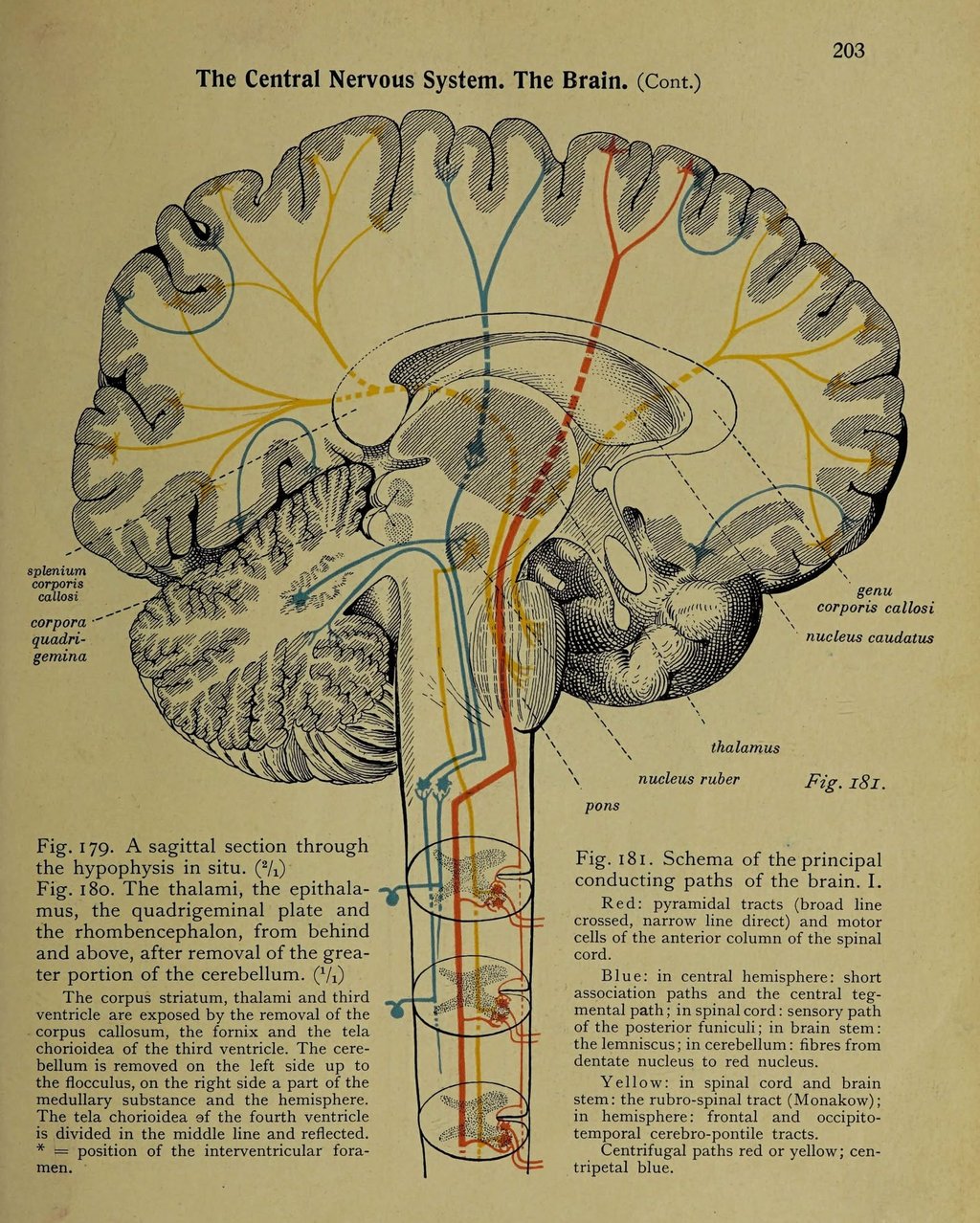
Image credit: Atlas of Human Anatomy, Johannes Sobotta, 1927–1928. Public Domain Mark. Source: Wellcome Collection.