
Hyperlexia and Dyslexia: Visual Directionality, and the Divergent Architecture Behind Language Processing
Explore the neuroscience behind reading, and language processing and the educational and systemic impacts
BIOLOGYPSYCHOLOGY
Alexandra Chambers
1/10/20268 min read


Artist: Frederic J. Mouat, 1849
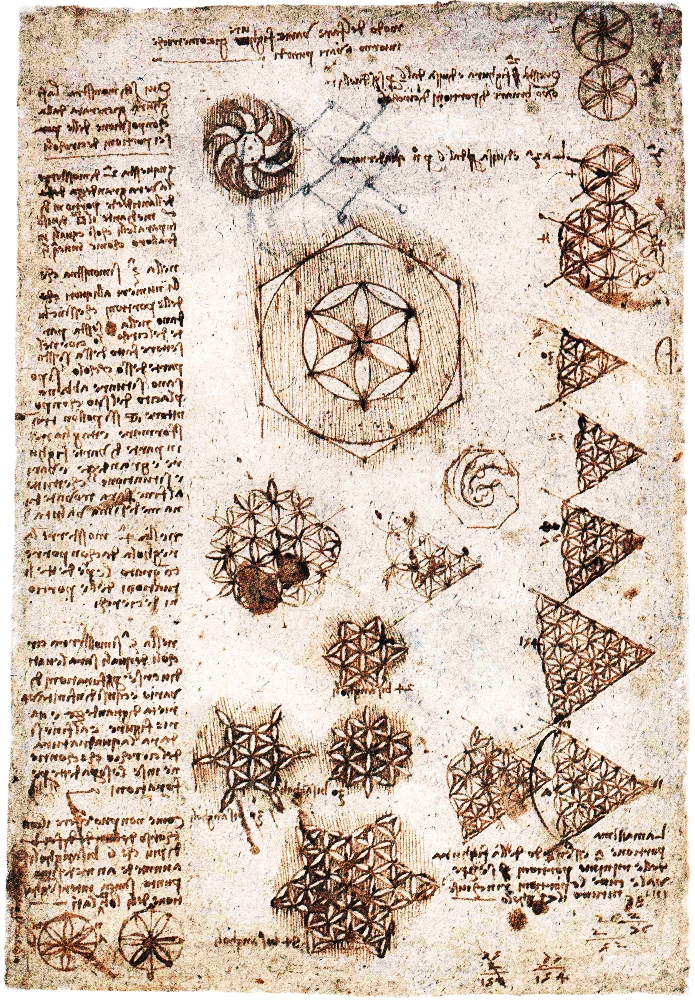
Artist: Leonardo da vinci "Flower of Life" 1478-1519
Modern reading systems are designed around a narrow set of neuro-visual and anatomical assumptions. They presume a brain that is left-hemisphere dominant for language, a visual system that comfortably tracks from left to right, and a body whose fine motor control aligns with right-handed writing. These assumptions are so deeply embedded into education, language, and literacy infrastructures that their biological exclusivity goes unquestioned. Divergence from this model is not rare though, and never was.
Neurodevelopment is not uniform; there is no 'normal'. However, society has been conditioned from birth that the majority define normative standards, and divergence has historically been marginalized via the systems and institutions around us.
The lateralisation of brain function - particularly the distribution of language, spatial, and visual tasks across the hemispheres - follows a spectrum. While language is usually housed in the left hemisphere, this is only a probability curve. Up to 30% of left-handed people demonstrate right-hemisphere language dominance, bilateral language representation, and non typical trajectories.
Genetic studies have identified variants associated with altered lateralisation patterns, including those linked to handedness, and language delay. These include polymorphisms near PCSK6, LRRTM1, and genes involved in axon guidance, inter hemispheric connectivity, and neuronal migration. Divergent lateralisation is not pathology - it is a legitimate outcome of neurodevelopmental diversity, often accompanied by novel perceptual strengths, multi-modal integration, or atypical cognitive sequencing.
Each eye receives input from both visual fields, but the left field of view from both eyes is processed by the right visual cortex, and the right field by the left cortex. This division occurs at the optic chiasm, an X like crossover point behind the eyes. As a result, when reading text that flows from left to right (as in English), the right hemisphere initially processes the left side of the page. In individuals with typical left-hemisphere dominance, this visual information is efficiently transferred across the corpus callosum to the left-sided language regions for decoding. In people with atypical lateralisation - including bilateral or right-hemisphere language profiles - this process can involve additional inter hemispheric negotiation.
This added neurological cost may manifest as delays in reading fluency, visual strain, or misalignment between perceptual intake and linguistic decoding. This is a structural mismatch between neuro-functional architecture and systemic design.

Mirror writing is a reproducible pattern observed in people with mixed handedness, and non-standard hemispheric dominance. It is also historically associated with polymaths and spatial thinkers - including Leonardo da Vinci, who wrote extensively from right to left using reversed glyphs. This was likely as a reflection of his visual-spatial dominance and left-handedness. Divergent populations may show functional organisation across the midline, rather than clear left/right division - resulting in simultaneous, rather than sequential, processing styles. Mirror writing is a visible output of that functional topology.
Systemically and practically, this is documented as error, pathology, or delay - rather than neurobiological divergence.
Reading is not purely cognitive; it is biomechanical. It depends on precise coordination of the extraocular muscles, ocular lens, and binocular fusion system. These structures are deeply influenced by connective tissue integrity - particularly collagen elasticity and fascial tone. In people with hypermobility syndromes, including Ehlers-Danlos Syndrome (EDS), ocular instability is common: convergence insufficiency, vergence fatigue, and transient misalignment of the visual axis can all create difficulty reading.
Connective tissue divergence is on a non-linear spectrum, like all neuro and biological diversities. Some may present with hypermobility (collagen variants that predispose looseness of connective tissue) and some hypomobility (collagen variants that predispose stiffness such as arthritic conditions) and others may present with early-onset presbyopia-like symptoms, reduced ciliary muscle flexibility, or decreased lens accommodation. These people may experience rigidity when shifting focus across depths, affecting both near vision and dynamic page tracking.
Additionally, interocular spacing (distance between the eyes) - determined during craniofacial morphogenesis - can alter binocular geometry. Wider-set eyes increase parallax and place greater load on fusion mechanisms; closer-set eyes, particularly in individuals with dense or stiff orbital tissue, may affect angle and focal alignment. Both extremes can result in reading discomfort, visual instability, or perceptual strain - especially under fluorescent or high-contrast conditions.
These are expressions of divergent structural development - often genomically grounded, and multi-systemically overlooked.
Mainstream reading disorder classifications - particularly phonological dyslexia - fail to capture the full diversity of divergent reading profiles.
· Some individuals process language auditorily but experience visual tracking issues.
· Others excel in spatial reasoning but struggle with phoneme sequencing.
· Some are hyperlexic, decoding words rapidly with slower integration.
· Others are hypolexic, preferring visual scene cognition over symbolic language entirely.
These profiles reflect differences in cortical hierarchy and sensory prioritisation. Visual-spatial dominant individuals may rely more heavily on the dorsal stream (motion, position, depth) than the ventral stream (form, identity).
Those with disrupted magnocellular function - implicated in some forms of visual dyslexia - may exhibit reduced sensitivity to movement, flicker, or spatial attention, leading to visual crowding and reading fatigue.
The failure is not in the reader; it is in the uniformity of the system.
Left-to-right reading is not a biological imperative - it is a cultural artifact. Languages such as Arabic, Hebrew, Syriac, and historical forms of Chinese and Japanese follow different directionality: right-to-left, vertical, or modular block formats. Neurological studies have shown that reading direction affects eye movement patterns, hemispheric activation, and even cognitive bias in spatial reasoning tasks.
Despite this, Western educational systems enforce a singular model of reading fluency, treating deviation as pathology rather than mismatch. Children who reverse letters, mirror shapes, or prefer alternate tracking directions are flagged for remediation, despite evidence that these may be developmentally appropriate expressions of alternative processing.
The page is rigid; but the brain is not.
There is no single cognitive path to language. Educational models, however, continue to demand alignment with a narrow neurodevelopmental blueprint - privileging phoneme sequencing, linear visual tracking, and black text on white backgrounds, regardless of sensory comfort or neurobiological organisation.
What would it mean to design adaptive literacy systems? Systems that allowed right-to-left tracking, mirror-format recognition, multi-sensory decoding, or nonlinear page layouts? A progressive framework should recognise form perception, eye movement variability, and biomechanical constraint as integral to reading - and not obstacles to be corrected.
I wonder how many right hemisphere dominant children are pressured into left hemisphere dominant literacy, and what happens to those in the middle somewhere...
What if the ability to read and write was not judged by how well a child conforms to the page - but by how well the page conforms to the child?
.selur eht etirwer ot emit s’ti ebyaM
Hyperlexia and Dyslexia
Hyperlexia and dyslexia are often treated as unrelated phenomena: one associated with unusually early or intense reading ability, the other with difficulty in reading, decoding, spelling, or written expression. Yet both may be better understood as distinct neurodevelopmental literacy profiles within the broader landscape of neurodivergence. They reflect different relationships between language, symbol, meaning, communication, and expression.
As previously mentioned, education and clinical assessment often rely on limited models of literacy; reading aloud, spelling accuracy, written fluency, verbal spontaneity, and classroom performance are frequently treated as reliable indicators of comprehension or intelligence. These measures can misrepresent both hyperlexic and dyslexic individuals. A child who reads early may be assumed to understand language in a typical way, even when their communication profile is complex. A child who struggles with decoding or writing may be assumed to have lower comprehension, even when their spoken reasoning, emotional insight, or conceptual understanding is highly developed. In both cases, the perception of the visible output may contribute to misunderstanding of the abilities present within the underlying cognitive architecture.
Hyperlexia is commonly associated with early reading, strong pattern recognition, symbol decoding, and a marked orientation toward written language. Hyperlexic individuals may appear to acquire reading without tuition, often before spoken communication has developed in expected ways. This can lead to a misunderstanding; hyperlexia is sometimes reduced to rote word recognition, as though the person can decode text without meaningful understanding. While this may be true - especially in some early childhood presentations - it is not sufficient as a general ongoing description. Many hyperlexic individuals demonstrate deep comprehension, sophisticated pattern detection, and strong internal language processing, although they may be unable to express that understanding verbally or spontaneously. Often hyperlexia coexists with alexithymia, therefore the individual may understand what they are reading but struggle to verbally explain what it means to demonstrate their comprehension. Alexithymia is not indicative of a lack of knowing; it is difficulty identifying, organising and expressing internal states via the limitations of verbal language.
For some hyperlexic people, written language may function as a natural communicative medium than speech. Writing offers time, structure, distance, and control over expression. It allows thought to be organised without the immediate pressure of social timing, verbal turn-taking, facial interpretation, and rapid pragmatic response. A hyperlexic child may therefore appear quiet, detached, overly literal, or less socially engaged, when in reality they may be processing extensively but communicating most fluently through written or internally structured language. Their difficulty may not be a lack of thought, but a mismatch between their strongest communicative mode and the demands of the environment.
In contrast, dyslexia is usually recognised through difficulty with reading, decoding, spelling, sequencing, or written output. However, dyslexia should not be mistaken for a lack of intelligence, imagination, or linguistic capacity. Many dyslexic individuals demonstrate strong oral reasoning, verbal expressiveness, narrative ability, emotional perception, spatial thinking, and intuitive understanding. Their difficulty often lies not in meaning itself, but in the symbolic systems through which meaning is conventionally assessed. Written language may be effortful, unstable, or slow, while spoken language, storytelling, image-based thinking, embodied understanding, or relational communication may be rich and highly developed.
This creates a profound educational problem. The classroom often privileges written accuracy, reading speed, spelling, and standardised output over the quality of thought. A dyslexic child may understand a concept deeply but be unable to demonstrate that understanding through conventional written tasks. They may speak with insight and fluency, yet lose marks or confidence because their written expression does not match their internal reasoning. Dyslexia therefore exposes the limits of systems that confuse literacy performance with cognitive capacity.
Hyperlexia and dyslexia can therefore be viewed as different orientations within the wider domain of language and literacy processing. Hyperlexia may pull inward toward text, syntax, symbol, structure, and pattern. Dyslexia may move outward through speech, image, embodiment, story, emotion, and relational meaning. They are different cognitive-linguistic profiles, each with strengths, vulnerabilities, and environmental conditions under which they may either flourish or be misunderstood.
There is also a wide middle ground, with many individuals do not fit neatly into either category. Some may read fluently but struggle to write. Some may speak well but prefer written communication. Others may absorb spoken information easily while finding reading slow or exhausting. Some shift between states depending on stress, fatigue, emotional state, audience, context, or medium. These mixed profiles are often overlooked because assessment systems tend to seek clear diagnostic categories, while real cognitive functioning is often dynamic, fluid and uneven.
Hyperlexia and dyslexia both reveal that language is not a single skill; reading, decoding, comprehension, speech, writing, spelling, storytelling, symbolic reasoning, auditory processing, and expressive communication can develop unevenly. A person may be highly capable in one domain while significantly challenged in another. This unevenness is not evidence of contradiction; it is evidence of complex neurodevelopmental organisation.
A progressive framework would recognise that literacy should not be reduced to observations of abilities to read aloud, spell correctly, or produce written work on demand. It is also the ability to interpret meaning, build internal models, recognise patterns, communicate ideas, absorb language, and express understanding through different channels. Some people think most clearly through writing, and some think most clearly through speech. Some require visual, spatial, rhythmic, relational, or embodied routes into meaning. These are not lesser forms of intelligence, they are different intelligent routes through language.
Hyperlexia and dyslexia therefore invite a broader reconsideration of how education, therapy, and assessment understand communication. Rather than forcing all children through the same narrow literacy pathway, we need frameworks that identify how each person processes, organises, and expresses knowledge. A child who writes pages but struggles to speak should not be assumed to lack understanding. A child who speaks brilliantly but struggles to write should not be treated as less capable. Both may be showing us that language is not linear, and that intelligence cannot be accurately measured through singlular modes of expression.