
Altered States: The Socially Violent Consequences of Functional Mania and Delusion
This article explores the societal perception, individual presentation and lesser understood aspects of manic and delusional states
PSYCHOLOGYPSYCHIATRYSYSTEMS
Alexandra Chambers
7/14/20269 min read
Common assumptions or misrepresentations of mania tend to be dramatic, or even theatrical. The person is visibly chaotic, extravagantly dressed, socially uninhibited, incoherent or behaving with such obvious eccentricity that nobody could possibly mistake them for well. They resemble the Mad Hatter at a tea party: disruptive, absurd and immediately recognisable. This is not an accurate representation of how mania or delusional states necessarily present in real life.
I use the term functional mania descriptively here. It describes a state in which practical and intellectual abilities present as intact while insight, inhibition, salience, certainty, sleep and risk perception have explicitly changed.
A person can remain articulate, intellectually functional and outwardly coherent while experiencing a serious alteration in mental state. They may continue working, attending appointments, and completing administrative processes. They may appear organised because many of their established cognitive abilities remain available to them.
What has changed is not typically their ability to perform tasks, but the internal conditions under which those tasks are being performed.
Their perception of risk may have altered significantly. Their confidence may have become unusually absolute. Their sense of scale, urgency and personal capacity may no longer resemble their ordinary baseline. They may no longer recognise the need for social and relational boundaries. They may require very little sleep, feel compelled to continue working and become increasingly certain that highly ambitious or consequential decisions are both necessary and achievable.
The person is still intelligent; but the way they use and express their intelligence has been altered.
A person in a functional manic state may be celebrated while their altered certainty remains productive. They may be described as visionary, fearless or exceptionally driven. When the same state produces consequences, collapse or contradiction, admiration can turn rapidly into condemnation. The qualities previously praised are retrospectively recast as recklessness, narcissism or dishonesty. The person goes from hero to villain overnight - because the altered state has ceased to produce socially desirable results.
Intelligence and delusion are not mutually exclusive. An intellectual, however, may be expected to recognise that their thinking has changed, challenge their own beliefs and reason themselves back into reality.
That assumption misunderstands both intelligence and delusion.
Intelligence is not an external observer standing outside the mind. It operates within the information, perceptions and emotional signals available to it. When those underlying signals become altered, the person may continue reasoning coherently from premises that no longer reflect their usual understanding of reality.
A delusional and/or manic person does not necessarily lose the ability to form arguments. They may instead become exceptionally skilled at explaining and defending conclusions produced by an altered state.
This makes intelligence an additional vulnerability in an altered state, not a benefit.
This can make the episode harder to recognise, as the person may sound persuasive - to themselves, and others. Technical competence, however, is not the same as accurate self-appraisal.
The ability to carry out a decision does not prove that the decision emerged from an unaltered state. Functioning is not evidence of wellness.
A person may retain most of their practical abilities while experiencing selective and serious changes in insight, inhibition, sleep, certainty and risk perception. In some cases, activity does not decrease but escalates. The person may become more productive, more decisive and more ambitious than they have ever appeared before.
This increase in activity can be mistaken for recovery, motivation or exceptional drive.
The danger is particularly easy to miss in divergent populations who have already learned to mask, to assimilate others for survival, or function through illness, exhaustion or disability. Someone who routinely overrides pain, fatigue and neurological symptoms may not recognise sleep deprivation and abnormal activation as altered state signs. They may interpret their sudden capacity to work continuously as evidence that they are finally functioning properly.
The experience can feel subjectively positive before it becomes catastrophic.
Conventional employment imposes external structure which may be a protective factor in identifying an altered state. An independent or self-employed person, writer, researcher, artist etc may be more vulnerable to concealment. There may be nobody present long enough to observe the loss of sleep, acceleration of ideas or disappearance of ordinary caution.
In that context, pathological intensity may be interpreted as entrepreneurial confidence or creative productivity.
The surrounding culture may reinforce this misinterpretation. Working through the night, pursuing several projects at once and displaying extreme certainty are often praised when they produce visible results. The behaviour may only be recognised as illness after the person has collapsed or the consequences have become impossible to ignore.
A manic/delusional episode may be temporary. Its administrative, financial, professional and relational consequences may persist forever.
A person may recover and realise that they have created something unsustainable, entered agreements, spent money, made public commitments, experienced disruptive or unsafe relationships or constructed an entire future that their well self would never have chosen whilst in a typical, regulated state.
This creates an atypical form of psychological dislocation.
The person inherits decisions made by themselves, but by a self whose judgment and sense of reality had significantly altered. Reports may carry their name, and conversations may have sounded coherent. Their actions may have been deliberate in the narrow sense that they knew what steps they were taking.
Yet the recovered person may no longer recognise the scale of certainty, urgency or perceived invulnerability that made those actions seem appropriate. They are then expected to manage the consequences from an entirely different state of mind.
There is very little practical guidance for this. Public discussion tends to focus on dramatic behaviour during mania, rather than on what happens afterwards. There is little support for reviewing contracts, financial obligations, relational damage, professional decisions or public commitments created during an episode.
The individual may therefore spend years repairing the material consequences while also attempting to understand what happened to them psychologically.
In some cases, that fallout becomes life-threatening in its own right.
The danger is not limited to what happens during the episode. The aftermath may involve exhaustion, collapse, loss or long term fragmentation of identity, financial fear, professional pressure and intense shame. A person can survive the acute altered state and still be brought close to death by what follows it.
For an intelligent and conscientious person, the most damaging consequence may be moral rather than administrative.
Society is poorly equipped to hold the complexity of somebody being both intelligent and delusional, both functional and manic, both apparently competent and seriously unwell.
Instead, people tend to divide human beings into simple categories.
If the person was intelligent, they should have known better. If they completed tasks, they must have understood what they were doing. If they appeared functional, they cannot have been seriously ill. If they were delusional, they should have been visibly irrational.
The person may internalise these contradictions. Unable to reconcile their intelligence with their altered state, they conclude that illness cannot adequately explain what happened. They begin to interpret their behaviour as evidence of a hidden moral defect.
Perhaps they were arrogant, dishonest, irresponsible.
Perhaps the episode revealed who they really were.
This is where the inability of other people to hold complexity becomes dangerous. When society identifies only two explanations - competent and responsible, or visibly ill and incapable - the functional manic person fits into neither. They remain intelligible enough to be blamed but not stereotypically unwell enough to be understood.
An intellectual person may then use their own analytical capacity against themselves. They review every decision, search for evidence of intention and construct an elaborate prosecution of their own character. Because they can identify the consequences, they assume they must also deserve the shame attached to them.
Intelligence does not protect the person from shame. It allows them to sustain it with greater sophistication.
Recognising that a person was in an altered state does not require pretending that their actions had no consequences. They may still need to address legal responsibilities, attempt to repair relationships, revise projects, repay money or acknowledge harm.
Practical responsibility remains. Moral blame requires a different analysis.
A person can take responsibility for managing the aftermath without accepting that becoming manic or delusional was a moral failure. They can recognise that actions were carried out by them while also recognising that those actions emerged from a state in which their judgment, certainty and perception of risk had changed profoundly.
The recovered person may already be carrying more responsibility than anybody else. They are often the one dealing with the paperwork, the financial consequences, the explanations and the fear that the state could return. They do not require additional punishment through the belief that serious illness 'exposed' them as fundamentally bad.
An explanation is not an excuse; it is an attempt to describe causation accurately.
Memory of an altered period may also be fragmented. Some moments may remain clear, while others feel distant, disjointed or difficult to reconstruct. The person may know that they completed sophisticated tasks without being able to recover the internal logic of the state that drove them.
This can intensify the sense of estrangement.
The period belongs to their biography, but it may not feel fully accessible to them. Other people can point to emails, documents and decisions as evidence that the person 'understood' what they were doing. Yet those records are external, they often do not allow visibility into the mind or it's logic.
Without a framework that allows intelligence and altered reality to coexist, the person may never fully understand their whole self.
Mental-health professionals are not immune from cultural stereotypes. A patient's ability to explain themselves can be misinterpreted as evidence that their capacity is fundamentally intact. This places too much weight on presentation during a short appointment.
The more relevant questions concern change from the person’s own baseline. How much were they sleeping? Had their activity increased dramatically? Were their plans expanding beyond their normal scale? Did they feel unusually invulnerable or certain? Were they taking risks that would ordinarily frighten them? Were they forcing themselves to function at a level that could not be sustained? Were they experiencing any other neurological or physiological difficulties?
Recovery from mania cannot be reduced to the disappearance of acute symptoms. The person may need help reconstructing the period, understanding the role of sleep and other neurological or psychological factors, reviewing commitments and separating enduring values from decisions shaped by altered certainty. They may need counselling and therapy for shame, self-alienation and the loss of trust in their own judgment. They may also need practical support. This might include reviewing contracts, finances, organisations and professional obligations. It may involve creating safeguards around future decisions, such as delaying major commitments, monitoring sleep or involving another trusted person when legal or financial risks are significant.
The truth is, however, that the individual may also receive no support at all, because the experience is logged socially as a personal character flaw. A psychiatrist may start the person on a medication, and that may be all that is done. The social fallout derived from manic and delusional states are often not acknowledged systemically.
The evidence suggests that intelligent and gifted people may be at higher risk of the altered states discussed, and are subsequently at higher risk of suicide over the impact.
They may look competent because they are competent in many respects. That does not mean they are safe.
When the episode ends, the individual may be left carrying a secret they believe nobody will understand: that they were functional, intelligent and profoundly altered at the same time. That complexity is difficult for society to accept.
Human minds are capable of preserving knowledge and skill while altering judgment, salience, insight and certainty. Serious illness does not have to erase the whole person in order to place their life in danger.
Sometimes the person does not look mad. Sometimes they look exceptionally capable.
That is precisely why nobody realises how close they are to being lost.
An altered state can end without returning the person to the life they occupied before it. In some cases, the restoration of insight initiates a more dangerous and less visible crisis.
The recovered person may internalise the same ableist reasoning. Because the actions were organised, they assume they must have represented their true character. The possibility that intelligence remained intact while judgment, salience, certainty and self-perception had altered may never be offered to them.
An intelligent person can also use their own analytical capacity to prosecute themselves.
They reconstruct events, identify every consequence and search for evidence of their own moral failure. They may conclude that the episode exposed a concealed arrogance, dishonesty or selfishness. Instead of understanding that their state altered, they come to believe that their apparent illness merely revealed who they had always been.
This can produce something resembling an ego death: a collapse of autobiographical and moral identity. The person can no longer reconcile who they believed themselves to be with what occurred during the episode. Their past self becomes alien, their present self becomes contaminated by shame, and their future self no longer feels trustworthy.
The result may be more than regret or embarrassment. It can involve horror, grief and a profound loss of the right to continue existing. Suicide may begin to appear not only as an escape from depressive suffering, but as a response to perceived moral irredeemability.
The psychiatric literature recognises post-psychotic depression, post-psychotic trauma, self-stigma and elevated suicide risk. However, these concepts are rarely assembled into a single account of what may happen when insight returns and the person confronts the social and material consequences of an altered state.
Shame is recorded as a symptom or associated factor, but the destruction of moral identity receives less attention.
The period after mania or psychosis should not be treated as safe merely because the most visible symptoms have resolved. For some people, the most dangerous stage begins when they cognitively process the reality.
Effective aftercare must provide a framework through which the person can integrate preserved intelligence with altered judgment, accept practical responsibility without assuming total moral blame, and reconstruct a coherent identity that does not reduce an episode of illness to evidence of bad character.
Without that reconstruction, a person may survive the altered state only to be traumatised by the shame attached to a moral identity they no longer recognise as their own.
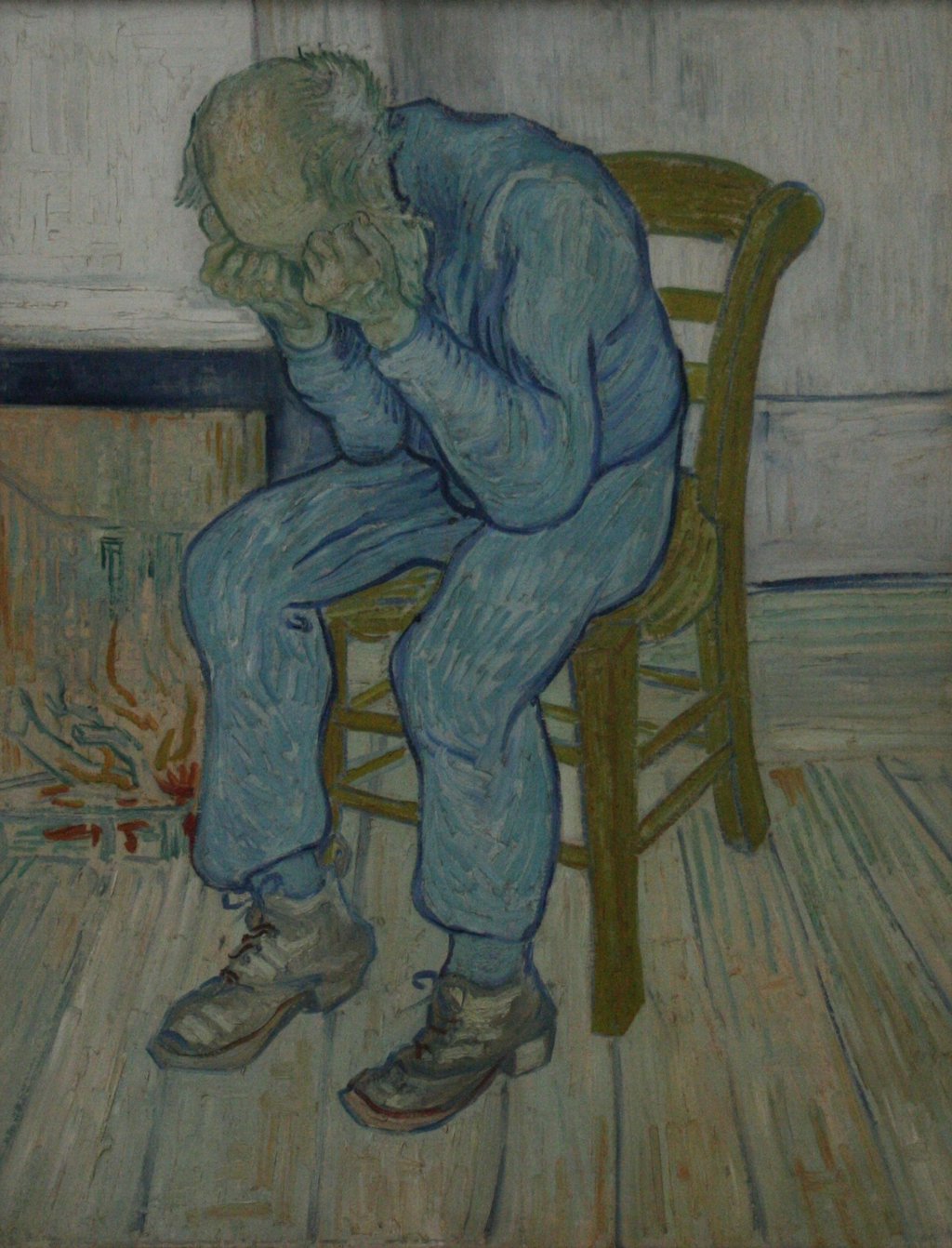
Artist: vincent Van gogh, sorrowing old man (At eternity's gate), 1890. Kroller-muller museum, otterlo. public domain